

Create an Event
- Open the Marketing tab from the Dashboard
- Click Events
- Click Get started
- Title the Event
- Select the Event date and time (Events can be scheduled up to one year in advance)
- Select the time zone
- Configure the Event as a one-time occurrence or recurring
- Click Save to begin customizing the Event
Add emails to an Event
Event actions set up registration emails, reminder emails, and follow-up emails linked to the start date and time of an Event.Note: If you set up a repeating Event, registrants receive the Event Emails from the time of their registration for the first time they register. Registrants will not continue to receive Event Emails for every repeating cycle unless they are de-registered and registered again.
Add Event Emails
- Open the Marketing tab from the Dashboard
- Click Events
- Select an existing Event or create a new one
- Click Add Email
- Choose when to send the email in relation to the Event in the When dropdown menu
- Click Save to keep the changes
Note: Event Emails are sent to Event registrants based on the specified date and time. If registrations occur after a scheduled email has been delivered, those registrants only receive the emails scheduled after the time of their registration. For example, if an email is set to send 15 minutes prior to the Event, registrations that occur after that 15-minute mark will not receive the email.
Unsubscribe from Event emails
Event Email recipients (Event Registrants) have the option to unsubscribe from Event Emails with Kajabi’s auto-generated Unsubscribe link at the bottom of each email:
Add to Calendar links for events
Add calendar links so members can save Events to their personal calendars. The Add to Calendar feature lets members quickly save scheduled Events to their preferred calendar. These links are automatically included in confirmation emails and appear on event pages, making it easier for members to attend and stay organized. Use this feature for any scheduled Event with a defined date and duration. This article explains where calendar links appear, how they work, and how to manage them in the event editor.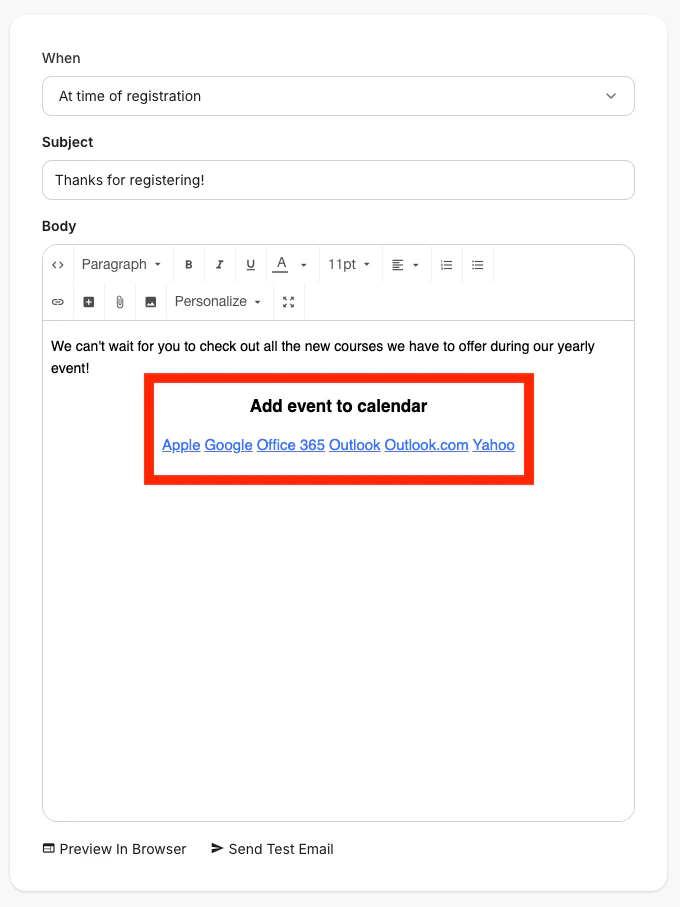
Supported calendar providers
Kajabi supports multiple calendar providers, each with slightly different behavior:- Apple Calendar — Downloads an ICS file and supports full recurring event series
- Google Calendar — Opens a direct link and supports full recurring event series
- Outlook (desktop) — Downloads an ICS file and supports single events only
- Outlook.com — Opens a direct link and supports single events only
- Office 365 — Opens a direct link and supports single events only
- Yahoo Calendar — Opens a direct link and supports single events only
Where calendar links appear
Members can access calendar links in the following places:- Event confirmation emails — Add to the email body using the Add to Email button
- Member-facing event pages — Displayed on the event detail view
Manage calendar links in the event admin
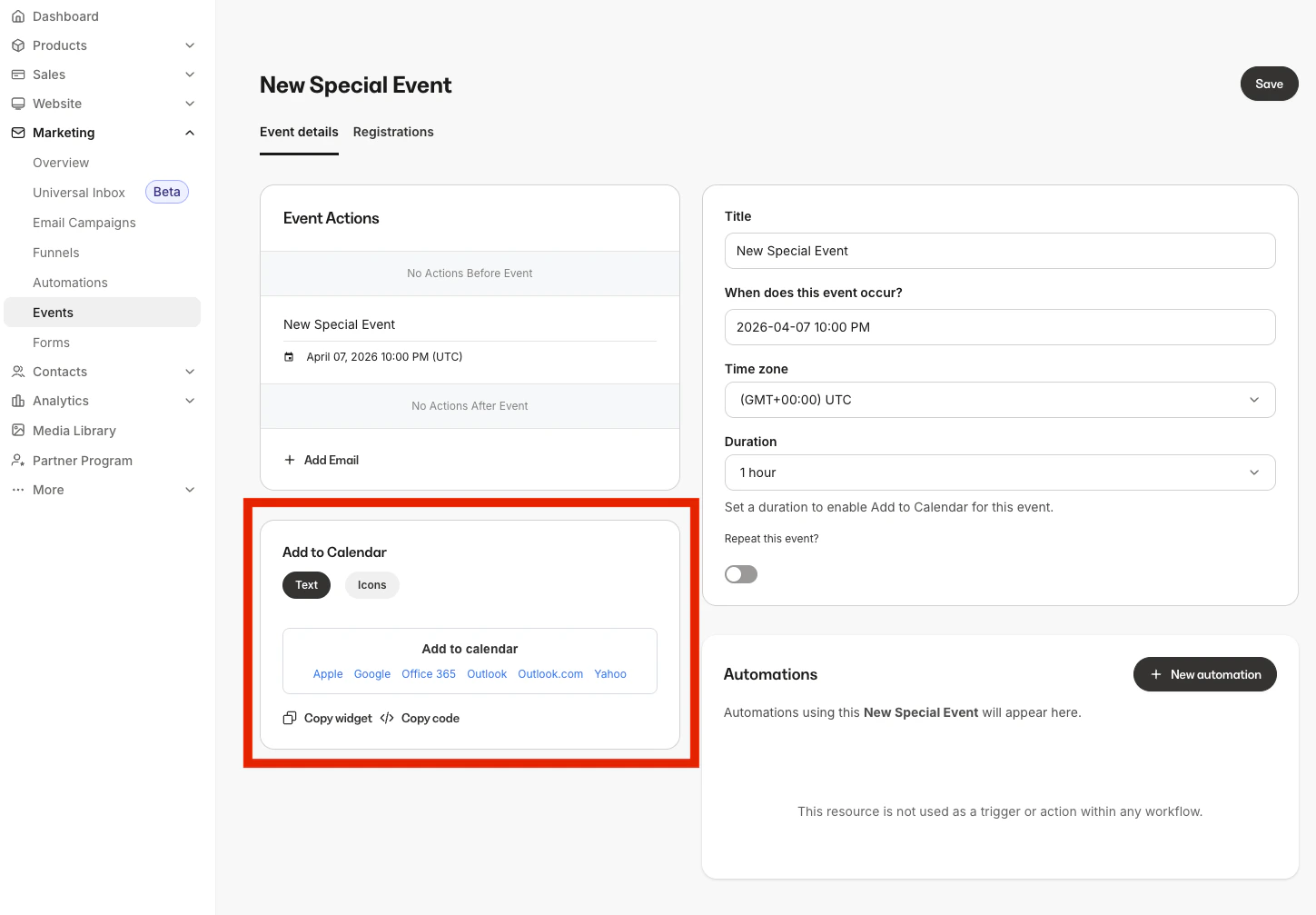
The event admin includes an Add to Calendar panel with tools to customize and share calendar links:- Text style — Display provider names as text links (e.g., Google, Apple, Outlook)
- Icon style — Display provider logos as clickable icons
- Copy widget — Copy formatted calendar links for use in emails or landing pages
- Copy code — Copy raw HTML for custom templates or advanced use
- Add to email — Insert the calendar widget directly into the email editor
How calendar links work
Each calendar link includes a secure, time-limited token tied to a specific Event. When a member clicks a link:- Google, Outlook.com, Office 365, Yahoo — Opens the provider’s event creation page with pre-filled details such as title, date, time, duration, and description
- Apple and Outlook (desktop) — Downloads an ICS file that the member opens to add the Event to their calendar
Important: Calendar links expire one year after they are generated.
Before you begin
Make sure the Event is fully configured so calendar links can appear:- Set a date and time for the Event
- Add a duration (in minutes)
Troubleshooting
Calendar links not appearing in email
- Cause: Event has no duration set
- Solution: Add a duration (in minutes) in the event settings
Calendar links not appearing
- Cause: Event is not scheduled
- Solution: Set a date and time for the Event
”Link expired” error
- Cause: Calendar link token is older than one year
- Solution: Request a new link from the event page
Recurring event shows only one session
- Cause: Provider limitation
- Solution: Apple Calendar and Google Calendar support full series. Other providers add only a single event by design.