

Overview
Challenges are a powerful way to engage your audience, showcase your expertise, and create momentum for your business. Whether you’re launching a product, building your email list, or growing your community, a well-planned challenge can make a significant impact.Set clear goals and define your audience
Every great challenge starts with a clear purpose. Are you looking to attract leads, convert followers into customers, or increase community engagement? Once you’ve identified your goal, define your ideal participant. Understanding their needs, interests, and challenges helps you create content that resonates.Plan engaging and achievable content
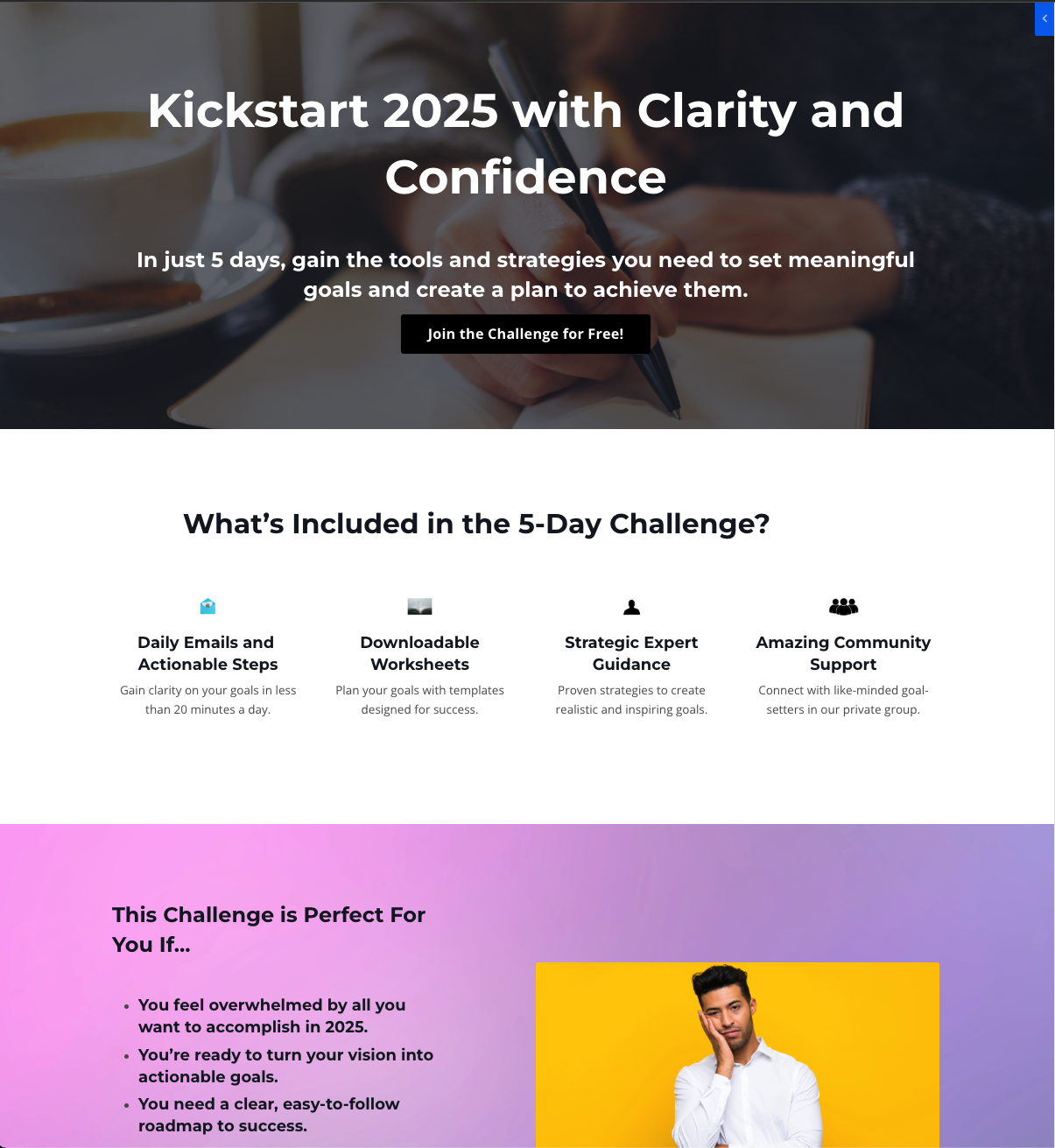
Challenges are most effective when they balance inspiration with actionable steps. Break your challenge into daily or weekly tasks that feel doable and rewarding. The content should align with your business niche while addressing your audience’s pain points.See a challenge built on Kajabi
This sample challenge was built using a landing page, custom thank you page, and follow-up email sequence.Note: This challenge is for inspiration only. While you can sign up via the opt-in page, the email sequence is only a template.
Offer a next step to sustain engagement
Your challenge shouldn’t end when the event is over. Keep momentum going by offering a next step that aligns with your audience’s journey. This could be a paid membership for ongoing support, a discounted coaching session, or an upsell to one of your products.Choose a compelling name for a challenge
The name of your challenge is the first thing potential participants see, so make it catchy and goal-oriented. Aim for a title that highlights the outcome they’ll achieve or the journey they’ll embark on. For example, a 5-day challenge could be called “5 Days to Kickstart Your Fitness Journey,” while a 7-day challenge might be “7 Days to Transform Your Morning Routine.” A great name sets the tone and generates excitement.5-day challenge ideas
- 5 Days to a Stronger [Skill/Outcome] (e.g., “5 Days to a Stronger Online Presence”)
- 5-Day [Theme] Reset (e.g., “5-Day Mindset Reset”)
- Master [Skill] in Just 5 Days (e.g., “Master Crochet Basics in Just 5 Days”)
- The 5-Day Quickstart to [Goal] (e.g., “The 5-Day Quickstart to Healthy Eating”)
- 5 Days to Kickstart Your [Outcome] (e.g., “5 Days to Kickstart Your Writing Habit”)
7-day challenge ideas
- 7 Days to [Outcome] Success (e.g., “7 Days to Social Media Success”)
- Your 7-Day [Skill] Journey (e.g., “Your 7-Day Productivity Journey”)
- 7 Days to Transform Your [Theme] (e.g., “7 Days to Transform Your Morning Routine”)
- The 7-Day [Outcome] Sprint (e.g., “The 7-Day Fitness Sprint”)
- 7 Days to Build Your [Skill/Outcome] (e.g., “7 Days to Build Your Brand Voice”)